First Port of Call
| March 21, 2023From the new terminal on the Haifa coast, it looks like China is taking over the Israeli shipping industry, but don’t worry, it’s just a 25-year lease
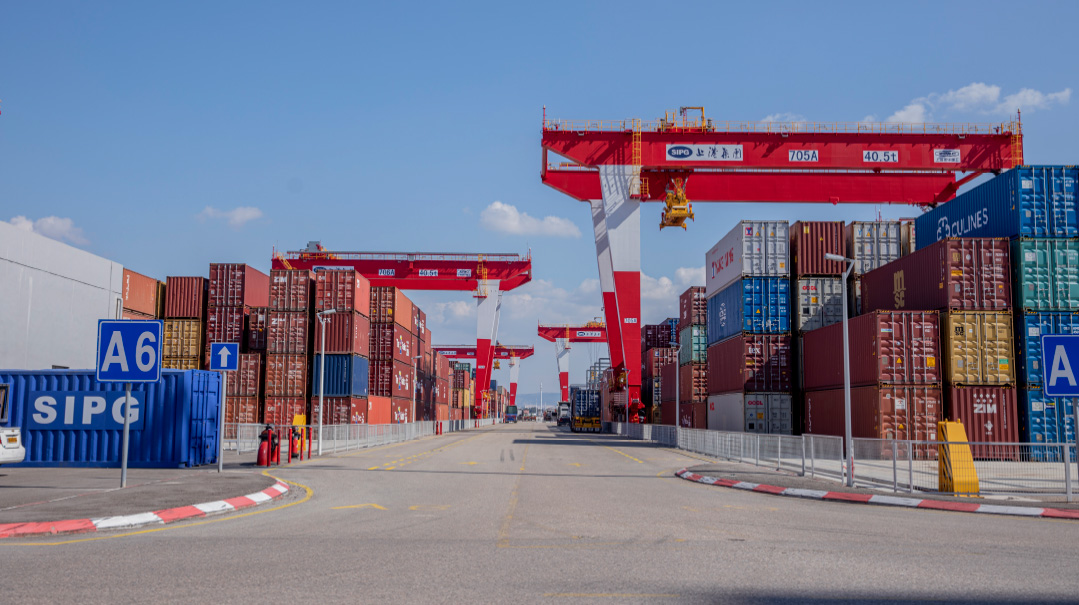
The first tip-off that the new Haifa port we’ve come to investigate belongs to another world was the large sign in Chinese that greeted us at the entrance to the SIPG (Shanghai International Port Group) Bayport Terminal in Haifa Bay. It might sound surprising, but this terminal on Israel’s northern Mediterranean coast is actually one of two new ports in Israel that were built and are managed by foreign operators following privatization reforms (the second is the Dutch-managed Southport Terminal in Ashdod).
Both are run according to what Israelis call the “slipper” system, a managing protocol that exists in several other ports around the world. Basically, it means that Israel provides the foreign group with a 25-year lease of “slippers” with which to walk around in its domain and operate the place without making muddy footprints.
But it’s not exactly that China is taking over Israel’s shipping industry. It’s just being operated by a Shanghai-based company — even though in Communist China, all businesses are tied to the Chinese government in an inextricable way.
Still, the first condition for the tenders in the new ports, which have been operating for the past year and a half, was that the operating company had to be a foreign international company in order to generate competition and bring to Israel the knowhow from other top-trading countries. Of course, China jumped at the opportunity. Access to the Middle Eastern and European markets via Haifa has always been a coveted asset, and China knows that its profit potential is enormous.
It’s been decades since a new port was built in Israel. While the old ports all belonged to the State, now, for the first time, the Chinese are creating competition with the Bayport Terminal, India’s Adani Group has begun operations in the old Haifa Port (which the Chinese bid on as well, but India — which has close relations with Israel — was favored so as not to provide China with too much influence in Israel, a possible strategic risk for the future), and in Ashdod, the Dutch are operating the Southport Terminal. All this will translate into cheaper goods and more purchasing power for the consumer.
RELATED CONTENT

For the managers of this costume closeout and their masses of customers, it’s the Adar spirit with no window dressing


Artist Yitzchok Moully has upped his message: to make the Jewish flame visible in the public sphere

If Poland is one giant Jewish graveyard, then Krakow is the gravestone
For developer Akiva Zuravin, cranes on Jerusalem’s skyline are the next chapters in the eternal story
Dan Groover's street murals aren't only a fun pop of color, but windows for layers of meaning