First Date
 | October 7, 2014
“Everything’s okay, honey. It’s just that your husband was brought in. He was in a car that spun out of control.”
“Don’t part with your illusions. When they are gone you may still exist but you have ceased to live”
Francois de Fenelon
Everything’s different tonight. For one thing, Shalom’s home early. Yes, he works on Chol Hamoed. Yes, we talk about it, or don’t talk about it, or scuttle around it until my words are like a coral-colored crab, coming at everything from the side. Tonight, though, he’s home at seven, instead of his usual 10:15.
Atarah emerges from her room and I drop a kiss on her forehead. She’s pale beneath the blush. The house is unusually quiet, the other kids all at their cousins. My sister has this thing for Succos sleepovers; tonight, it’s a heaven-sent blessing.
“Ready?”
A nod.
She’s going out for the first time tonight. The boy — a Yair Landstrom — sounded good through all our enquiries, as we poked through the words to find hints of trouble, or maybe even droplets of truth. A learner — not one of the sparkly, insecure types who asks questions to make the rosh yeshivah frown in concentration and who has a small following of chassidim. The solid, dependable type. Atarah needs that. She’s like Shalom. Besides, I couldn’t bear the thought of her going out with some firecracker of a boy.
I’ve got a show on tonight, so I splurged on a cleaning lady and the house looks great. So great that I’m not even embarrassed when there’s a light tap on the door and in walks Yair Landstrom, hat set back on his face, cheeks tinged with uncertainty. Sweet. He talks to Shalom in the dining room and then we usher the pair — couple? — out the front door. Atarah ducks back to give me a kiss goodbye. And then, in a flash of dark brown hair and light peach silk, she is gone for the night.
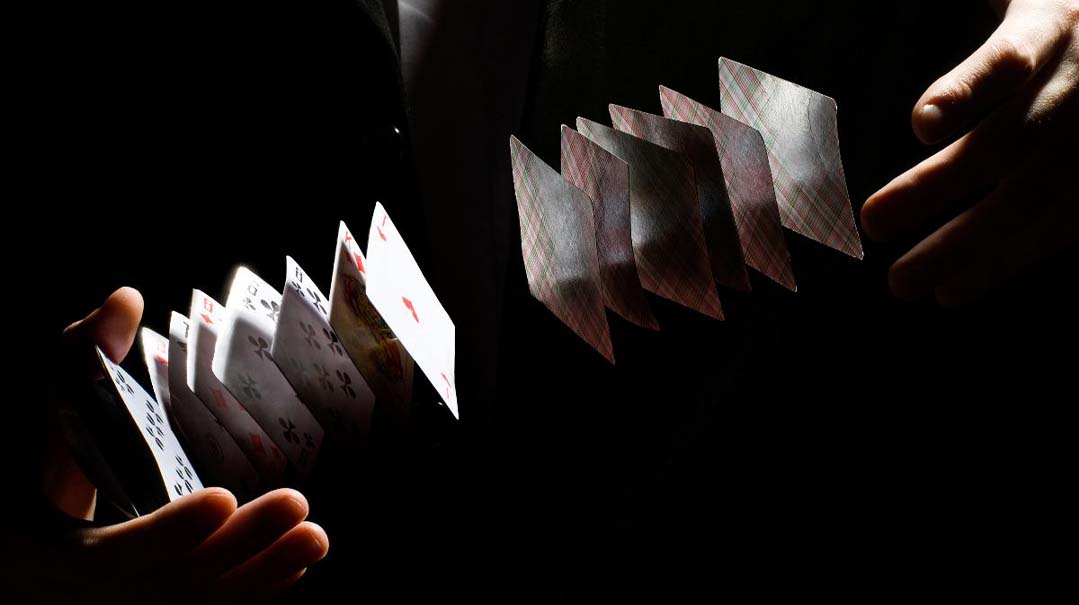
I close the oak door to a feeling of bereavement. I can’t help but think of the first time I met Shalom, all those years ago. I was into magic tricks back then, too, helping out at bas mitzvah parties, babysitting kids no one else wanted to watch. I called it sleight of hand, just to be safe, so I wouldn’t be stuck with a label that would be too heavy to carry through shidduchim.
In the middle of our date, when there was a small amount of Coke in my glass — danger point, where a slip can turn into a slurp — and conversation was sparse, I took a deck of cards from my pocket and told him to pick a card, any card, and keep it to yourself.
My sister was mortified when I gave her my post-date report, but the shadchan said that Shalom thought the date went okay, not great, but not bad either. And he wanted to see me again to know the secret of that card trick.
In 20 minutes, maybe less, a bus of 40 girls will pull up outside the house. They’re coming straight from the ice-skating rink and are heading on to pizza. They’ve come for an hour of gasp-inducing, wondrous illusions from a famed magician. That’s me. Ha.
I started my job when Shalom decided that he had not just one family to support, but two. And money didn’t grow on trees, it couldn’t be magicked out of thin air, poof. But then we realized, well, maybe it could. I started off small — a birthday party here, a Bnos performance there. But word of mouth did its job and soon I was doing, three, four shows a week. In the summer, it could sometimes be three shows a day.
Now I mainly work at the rehab center, coaxing stroke victims to shuffle my cards and pluck coins from the air, to help them regain movement and dexterity. I still do shows, though, especially on Chol Hamoed when mothers are desperate to keep their daughters entertained, somehow, anyhow.
Tonight, the extra nerves give my performance an edge. I flit around the house, adjusting cushions, washing the single glass in the sink, until there’s a knock and the girls pour into my basement wonderland.
“Who’s coming to feel the coin?” I ask when the girls are quiet and have loosened up enough that I’m in command of the audience. It’s a silver dollar, wrapped up in a piece of pale blue paper. Half a dozen girls raise their hands. I choose a blonde girl with unreal violet eyes who sits toward the edge of the group. She stands and takes a skip toward me; blushes, realizing she is too old to betray enthusiasm, and the skip turns into a lope. Beside me, she smells of expensive fabric conditioner and I make a big show of asking her name: 50 percent of a show’s success is not about the illusions, but the way you work the audience.
“Yael Reiner.”
I look at her once. Twice.
The basement spotlight is too hot. My sheitel sticks to my neck.
The last time I met Yael Reiner she was maybe three years old, clutching a stuffed giraffe with an impossibly long neck. I was at the hospital, shadowing Rita Evans, the chaplain with a pink rinse and a tendency to call strangers honey and pull them into big, motherly hugs.
Little Yael had — thank G-d — been strapped into a car seat when a driver had lost control and slammed into her father’s SUV. She was fine, not a scratch, just confused. She was thrust toward me and I took her into a side room and tried to distract her by throwing my voice so it came out of the giraffe. I’d read about the principles of ventriloquism, never tried it before. Every so often a doctor banged in, stared, and backed out. The father was in surgery, I heard. I acted that giraffe like my life depended on it. Not just for Yael, but to keep my own mind off the horror. So hard to see Yidden there in the hospital, hear their stories, watch the wholeness of their lives desiccating.
“I’m cold, says Mr. Giraffe. And he goes to one store and another and none of them — not one — have a scarf long enough to keep him w—”
Mrs. Evans tapped me on the arm. “Aviva, honey,” she said, “I’ll take over.”
Yael pouted. “But giraffe still cold! Freezing.”
I shook my head at Mrs. Evans. She crouched down beside me. “Everything’s okay, honey. It’s just that your husband was brought in. He was in a car that spun out of control.”
I focused on a blonde ringlet that quivered just above Yael’s left eyebrow. I was still holding the giraffe, and I pointed with it.
“That’s right. It hit this little girl’s daddy.”
And now, here she is, at 12 maybe 13 — short, a little round-shouldered, violet eyes that would eat me alive if she was my daughter. I drape my arm around her shoulder and try to ignore the tremble of my hand. I wonder if she’s the type of kid who keeps her stuffed animals.
“Well, Yael Reiner is going to tell us all: Is there a coin in the paper?”
Cheeks slightly pink, Yael nods to the audience.
“Out loud! Come on now!”
“Yep! There’s a coin inside.”
I lift the paper high so all the girls can see it and rip the paper — with the coin inside — into shreds.
“How did you do that?” they chorus.
“Well, Yael, thanks for the help. Let’s all give a round of applause for Yael Reiner. I’ll be calling on you again.”
I never do that. I never call the same girl twice. But Yael Reiner. If I haven’t spent half of my life making sure their rent is paid, and electricity, too. If I haven’t slipped extra under their door before school starts in September, and before Yom Tov, so she can have a new outfit even as I do without. In not too many years, I’ll — we’ll — be marrying her off. My thoughts flit to Atarah and how her date is going, and I have to pull myself back to my audience.
I break with the magic for a juggling routine. It’s Succos, so I lead them all out under the night sky, though it’s so cold that my breath comes out in little puffs of white — but who needs a roof over your head? Who needs anything when there’s a fire before you, inside you, glowing just out of reach. I pick up my clubs and light the tips, so that they’re a faerie fountain of silver and red against the black-cloaked heavens. I add another, and another, and all of a sudden I hear a clap, a familiar clap, it’s the sound made when two large, slightly flabby palms catch the night sky between them and explode. Shalom. He’s out here, watching the show.
I’m glad, suddenly, that it’s dark and no one sees the color that floods my cheeks.
I toss the clubs to the side and light a torch: a yellow-red flame that climbs higher, higher. The background music reaches a crescendo as I lean forward and swallow the fire. Forty girls gasp. I knew they would. People think it’s special but it’s the most obvious thing in the world. Absence of air. With nothing to feed it, the fire goes out. I look over at Shalom and suddenly the fire inside me dims. Dies. That’s all it takes to extinguish a flame.
I’m almost finished the show, and I have a pretty cool illusion with a goldfish and a vicious rabbit who keeps tearing through the netting of its cage. Before I start, I dangle the offer: “So, who wants to know how it’s really done?” I think originally it was our rav’s idea, a kind of spiritual insurance policy against the whole magic scene. I let them see how I set it all up, the sleight of hand behind the illusion.
When I ask who wants to see, my audience is usually divided. I see people closing their eyes, peeking between fingers, or looking down at their shoes. The other half stares right up at me, letting out a collective aaah as, step-by-step, they watch me set up the trick.
Shalom’s still here, watching me, and I wonder: Will he hide his eyes and enjoy the thrill of the illusion? Or will he look, carefully drinking in each of my moves, so he sees through the magic?
With one finger on my lips, I show my audience the pellet under my thumbnail that releases a plume of green smoke. In a minute, when I’ve attached the hose to the underside of the table, the others will look up and hey, the goldfish — and the water (that’s the really cool bit) — have disappeared, and Rambo rabbit sits there beside an empty fish tank.
I always wonder: If I were in the audience, would I look, or hide my eyes, leaving the illusion intact? And then I laugh at myself, bitter. What’s the question? I’ve been living in an illusion — the appearance of a solid family, great marriage — since the day I met Yael Reiner. I’m sure Shalom, too, will hide his face, allowing the show to continue — who wants the truth to stir up the chemicals beneath the flames?
But then I look up and see that, although both hands cover his face, those crinkled, wide fingers — they’re split apart. He’s peeking.
For the first time in 23 years of marriage, I’m surprised.
RECOMMENDED





RELATED CONTENT

Now Jacob’s pathetic cries were a mockery, and I trembled, my knees pulled tight up to my chin. I could not, would not hold him in my arms and watch him slip away. Not again

“You need to choose to fight this monster or he’ll get the better of you. You can live a happy life, you can break free of this. The first step is to want to get better.”

Wrinkles are an honor when grandchildren count them. He has his four grandchildren from his son Meir. I, as he’s well aware, am a bubby to no one.

Sometimes you need to play nice, and dumb, and keep your insights to yourself. Sometimes you walk away even when you probably should stay. And you never tell people the answer — they need to get it themselves

“It’s your job, to make her smile, to bring her happiness, and a girl like this, she can use it. You’ll know what you have to do. It’s not as easy as you think, but it’s also not so hard.”

What does that feel like, to be at peace with your lot in life, even if that lot is standing at the corner of Kikar Shabbos and Malchei Yisrael on a cool Jerusalem morning, annoying everyone within a ten-mile radius?