Built to Endure
 | April 8, 2025
In Yeshivas Telz, Rav Leizer Gordon set a lasting gold standard
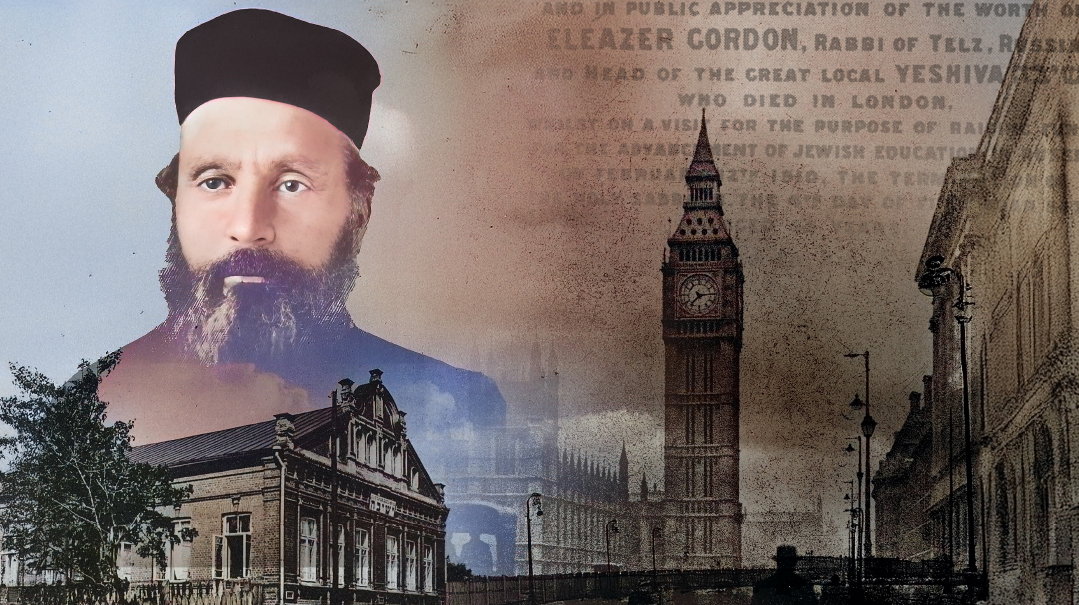
PHOTO CREDITS: Lithuanian State Archives, Yeshiva University Archives, Stein Family Collection, Telz Yeshiva Archives, Rabbi Pini Dunner, Pearl Family, National Library of Israel, Rabbi Dovid Kamenetsky, LIMIS: Collection of Lithuanian National Museums, The National Archives of the United Kingdom, DMS Yeshiva Archives
By Dovi Safier with additional research by Moshe Dembitzer
Rav Leizer Gordon carried dual leadership roles, and he blazed a new trail in both. As rosh yeshivah of the newly-established yeshivah in Telz, he built an educational structure that is still the gold standard of today’s yeshivah world. As rav of a town caught in the crosshairs of the enlightenment, he fought like a lion to preserve the purity of the mesorah.
But more than his educational foresight or his strategic efforts to build a Torah-true coalition across Europe, it was his personal example – a leader who gave away his last ruble to struggling students, the sparks that flew during his shiurim, the magnetic pull of a good kashe, his utter submersion in the sugya – that inspired his talmidim most.
One hundred fifteen years after his passing on foreign soil, far from his beloved Telz, Rav Leizer Gordon’s consuming passion for Torah learning still resonates — in the structure, substance, and spirit of the yeshivah world today
London, February 1910
A bleak winter sky hung over the thousands of mourners gathered outside the Philpot Street Great Synagogue on London’s East End. They had come to pay their final respects to one of the great luminaries of Lithuanian Jewry, Rav Eliezer (Leizer) Gordon, the venerable rosh yeshivah of Telz. From the temporary platform erected in front of the edifice, a passionate cry pierced the silence, echoing across the square. The voice belonged to
Dayan Shmuel Yitzchak Hillman (1868–1953) of Glasgow, a close friend of Rav Leizer. He was delivering a fiery hesped that would remain etched in the listeners’ memories.
Dayan Hillman implored the crowd to imagine that the departed sage was speaking to them:
“Surely we would hear him echo Yosef Hatzaddik’s own words,” he thundered. “‘I have been stolen away from the land of the Hebrews…. And here, too, I have done nothing… rather they have put me in the pit!’”
In a voice choked with emotion, Dayan Hillman applied the biblical verse to Rav Leizer’s tragedy: After a lifetime devoted to Torah, he had “stolen away” from his homeland to seek support for his yeshivah, which had been destroyed by a fire, only to receive little for his efforts and then be lowered into a dark grave far from home.
“If the death of this great scholar in our city has moved our hearts,” Hillman urged, “we must respond by supporting his holy yeshivah, so that even after his passing, it will stand strong and not collapse.”
Rav Hillman’s dramatic words sparked an immediate outpouring of support. Within days, London’s Jewish community rallied to raise the funds Rav Leizer had sought in life — enough to cover the debts incurred for the rebuilding of the yeshivah and provide for Rav Leizer’s bereaved family.
The sorrow of his untimely passing turned into a surge of resolve to uphold the legacy of this “prince of Torah, pillar of reverence,” as one contemporary described him.
In fact, Rav Leizer Gordon’s influence did not end with his death; in many ways, it only grew, inspiring others to carry on the torch of Torah he had ignited.
To understand how Rav Leizer earned such reverence — from humble beginnings in a small Russian village to the helm of one of the region’s most elite yeshivos — we must journey back to his early years. His story is one of genius and dedication, of innovation and indefatigable love of Torah. It is the story of a man who, through sheer force of vision, rebuilt and reimagined the Lithuanian yeshivah, and whose mesirus nefesh for Torah left an indelible mark on Jewish history.
CHAPTER 1: EARLY GREATNESS
Watched Over by A Wolf
Rav Eliezer Gordon was likely born in 1938 in a small village near Svir in the Vilna Province of the Russian Empire. From the very start, his life seemed touched by obvious Providence. Family lore recounts a harrowing incident on the way to his bris that became an omen of his future greatness.
As infant Eliezer’s parents traveled by horse-drawn sleigh to the neighboring town of Svir for the ceremony, the blanketed baby somehow slipped off. By the time the Gordons realized the child was missing, they had gone quite a distance. Panicked, they retraced their route and finally found little Eliezer lying at the edge of a forest — with a wild wolf standing guard over him. Fearing the worst, they approached to see that the wolf had not harmed the baby at all. It was as if the beast had been sent from Heaven to protect him. Only once the infant was safely retrieved did the wolf depart.
This miraculous episode made a deep impression on all who heard it, and the family took it as a Divine sign that this child had been saved by the Creator in order to actualize a special mission. In gratitude, when the bris took place, the name Eliezer (“G-d has helped”) was given. And signposts of Divine help and direction continued to guide him throughout his life.
Eliezer’s father, Rav Avraham Shmuel Gordon, supported his family by working as an innkeeper and maker of spirits — but he drew his true sustenance from Torah. A serious scholar who devoted his nights to deep Torah study, he had been a disciple of Rav Chaim Volozhiner and regularly journeyed back to Volozhin to discuss Torah topics with Rav Chaim's successors following his passing in 1921.
In that humble home, young Leizer (as he was affectionately called) imbibed both profound Torah knowledge and an ethos of diligence. Recognizing their son’s precocious intellect, his parents sought the best Torah education for him. As a young boy, Eliezer began studying under the tutelage of Rav Moshe Mordechai of Shventzian (the city of Rav Avraham Shmuel's birth), and he quickly earned a reputation as an illui (prodigy) with an insatiable appetite for learning. He continued his studies at the famed Zaretza Yeshivah in Vilna, honing his skills in the city’s vigorous Torah environment.
The Neviazher Era
Arriving in Kovno as a mere youth, Leizer Gordon joined the Neviazher Kloiz, which was at that time one of the foremost Torah centers in Russian-controlled Lithuania. In Eastern Europe, the term “kloiz” referred to a small beis medrash or study hall for advanced learning, often maintained by a guild or a private benefactor.
The Neviazher Kloiz was the base for Rav Yisrael Salanter’s pioneering yeshivah and was famed for its intensive learning and atmosphere of yiras Shamayim (piety). The yeshivah numbered about 150 select students and included many future luminaries of the Jewish world. Among Rav Leizer’s peers were giants who would leave an indelible imprint on the Jewry of Eastern Europe and beyond, such as Rav Simcha Zissel Ziv (1824–1898), later to be known as the Alter of Kelm; Rav Naftali Amsterdam (1832–1916); Rav Yerucham Yehuda Leib Perlman (1835–1896), the future “Gadol of Minsk”; Rav Yitzchak Blazer (1837–1907), who would become famous as Reb Itzele Peterburger upon assuming the position of Chief Rabbi of St. Petersburg; and Rav Yaakov Yosef (1840–1902), fated to become the first and final “Chief Rabbi” of New York City.
Rav Yisrael Salanter recognized something special in the young Eliezer Gordon, who frequently engaged him in conversation on Torah thoughts. Once, on the fast day of 17 Tammuz, Rav Yisrael went up to the amud to light his pipe from the candle that was burning there, and Rav Eliezer came up to ask a question in learning. The two immediately plunged deep into discussion. So absorbed did they become that neither noticed the hours passing, until worshippers entered the shul and informed them it was time for Minchah.
Despite his youth, Rav Yisrael appointed Rav Leizer to deliver regular shiurim in the kloiz. When Rav Leizer initially hesitated to take on this role, Rav Salanter promised to personally alternate with him by delivering two shiurim each week for the first six months. Due to health issues, Rav Yisrael left for Germany before fully implementing this arrangement. However, he returned to Kovno briefly and delivered a lecture to Rav Leizer’s students as promised.
Rav Leizer later recalled this period in a 1906 letter to Rav Yitzchak Blazer:
“I remember that when I was living with my father-in-law, Rav Yisrael Salanter encouraged me to begin teaching young students. He believed that my pilpul came close to the true meaning of the text and that my efforts to understand everything with straightforward and deep logic and with clear thought… with which Hashem has graced me, would have a great influence on the young students. Rav Yisrael was so invested in this approach that he promised to personally deliver shiurim alongside mine for the first six months. However, he later traveled abroad, but when he returned to Kovno briefly, he fulfilled his promise by delivering one lecture to the students that I had taught in Kovno.”
Rav Yisrael Salanter’s moral impact remained with Rav Leizer for life. Years later, when Rav Leizer was serving as a rosh yeshivah (possibly in Kelm), Rav Leizer asked Rav Yisrael Salanter to be present when the great Russian philanthropist Baron David Günzburg (1857–1910) made a scheduled visit to his yeshivah. Rav Leizer began dancing with joy when he showed the distinguished guests the hundreds of students filling the study hall from wall to wall, all absorbed in their learning. In return, Rav Yisrael asked him whether he would be as joyous were he to see such a glorious sight in a yeshivah not his own.
Who Sustains Us?
It was no surprise when in 1856, Rav Leizer received a shidduch proposal: Sarah Miriam (1841–1880), the daughter of Rav Avraham Yitzchak Neviazher (1810–1873), a wealthy scholar who served as dayan in Kovno, and the brother of the renowned patron of the Kloiz, Rav Tzvi Hirsh Neviazher. Marrying Sarah Miriam allowed Rav Leizer to focus entirely on his Torah studies, as his father-in-law provided financial support for the young couple.
As Rav Leizer’s reputation grew, he began receiving offers of rabbinic positions. Even after several sons and daughters were born to Rav Leizer and his wife, Rav Avraham Yitzchak continued to support the family, refusing to permit his son-in-law to assume any rabbinical position.
When several years had passed and his fame had spread to the surrounding cities, Rav Leizer was offered a distinguished and well-paying position as rabbi of the town of Aliksot, but his father-in-law still would not agree to let him go. This despite the fact that Rav Avraham Yitzchak’s own financial situation had grown strained, for he accepted no remuneration from the Kovno community, preferring to glean his livelihood from other sources.
When his wife protested, “How long will we continue to maintain him in our home? Our sustenance comes with such great difficulty!” Rav Avraham Yitzchak replied, “Who knows who is sustaining whom, whether we are sustaining him with our food and drink or whether he is maintaining us with his Torah!”
When his son-in-law was later offered a position by the community of Eishishok, he reiterated these same words.
But when the Slabodka community expressed their wish to crown Rav Leizer as their spiritual leader, his father-in-law did not forbid him from taking the position. Rav Leizer’s youngest son-in-law, Rav Zalman Sorotzkin (Rav of Lutsk), related the sequel.
On the day that Rav Eliezer was scheduled to leave his father-in-law’s house, Rav Avraham Yitzchak Neviazher returned from the beis medrash with his tallis and tefillin under his arm. As he stepped into the house, he keeled over — dead. His pious wife eulogized him in these words:
“Woe unto me! I killed you! Did you not say to me, ‘Who knows who is sustaining whom?’ Now I see that he sustained us, and that in the merit of his Torah we were granted life!”
After this tragic event, Rav Leizer decided not to proceed to Slabodka. For the next period, he remained in Kovno, and word of his greatness continued to spread.
RELATED CONTENT

Jewish Panama may be known for wealth, but its real treasure is a Torah revival
Rav Yitzchak Biton and his wife, Tamar, have become powerful symbols of faith for a nation under fire

A former financial wiz bridges the gap between virtual reality and eternal content
The Pnei Menachem's youngest child opens a rare window into his father’s mesirus nefesh for his chassidim — and for every Yid