Wheels of Fortune
| November 11, 2025He designed Europe’s most iconic car. Now he’s recalibrating life in a different lane
Photos: Elchanan Kotler
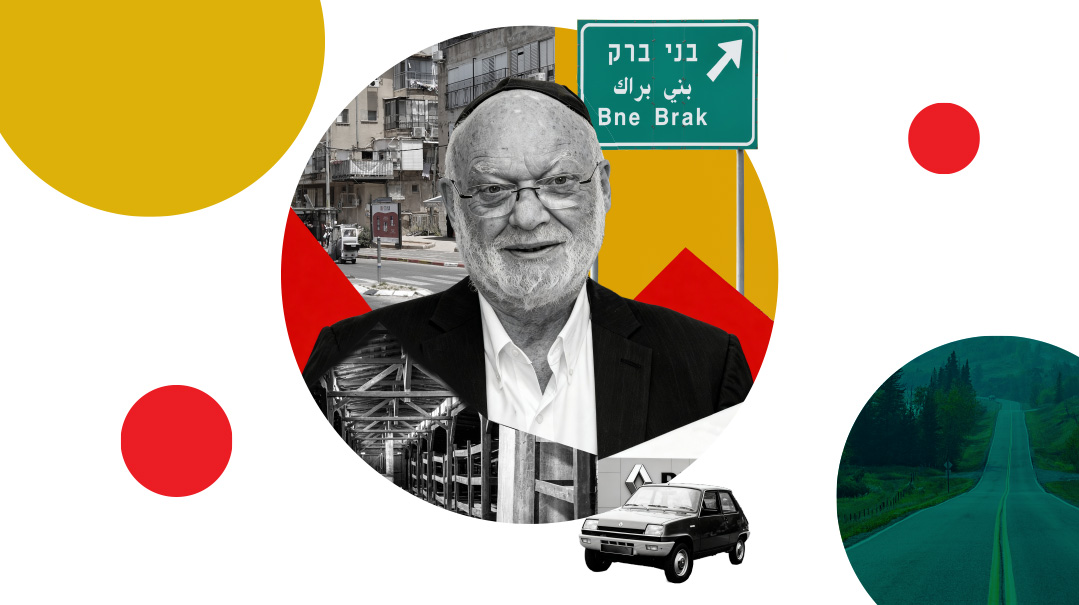
He’s taken more roads than most men ever dream of — from Auschwitz to Paris, from the boardrooms of Renault to the batei medrash of Bnei Brak. Dr. Efraim (Francois) Wasservogel, the visionary who reimagined the needs of modern drivers and designed one of Europe’s most iconic cars, is now steering his life in a very different lane. Because some journeys don’t end — they just recalibrate
Walking down Devorah Haneviah Street in Bnei Brak, you might run into Efraim (Francois) and Batia Wasservogel, who look like any other of the myriad retired couples living in the city. But Efraim Wasservogel’s humble demeanor as an 80-something late-stage kollel avreich belies a past that brought him to the peak of the European automobile industry and has continued to make him a sought-after consultant for giant companies all over the world. A mathematician and economist by profession, he was the creator of the Renault 5, a cult classic vehicle that was Europe’s best-selling car in the ’70s and ’80s and is still a market leader in 2025 — while he has since driven in another direction.
And he was also one of just a few babies out of thousands born in Auschwitz who actually survived until liberation.
In conversation, Dr. Wasservogel is self-effacing, playing down or joking about his front-seat role in science and industry. And while today he spends his mornings in the beis medrash, he was born into and grew up in a family that was utterly assimilated — which, providentially, was one reason in the natural order of things for his miraculous survival.
“The Nazis killed my father and my family before I was born,” he relates. “My mother, Myriam, from a cultured family, was a lawyer who had studied in a Polish university and spoke flawless Polish, with no trace of a Yiddish accent — she didn’t speak Yiddish. Since she was blonde, too, she was able to pass herself off as a Christian during the war.”
Myriam was married to a Polish Jew named Yosef Tzimmer, who was a pianist and mathematician. They lived in the Lvov region until 1943. Like many of their compatriots, Yosef and Myriam Tzimmer tried to escape the horror, but were denounced. Yosef Tzimmer was shot in front of his wife, who managed to save her life and the life of her unborn child by passing herself off as a Polish Catholic. Still, she was arrested for “associating with a Jew” and taken to the Lvov prison, and from there to the part of Auschwitz adjacent to the extermination camp that served as a prison camp for Gypsies and other people the Nazis detested. Francois Efraim was born on December 2, 1943, in Auschwitz.
“Because she’d passed herself off as a Christian, my mother was allowed to give birth and raise me,” Dr. Wasservogel says, reflecting on how he survived thanks to his mother’s deception and special Providence. (Until mid-1943, all babies born in Auschwitz were immediately murdered; but from then until liberation, non-Jewish newborns were sometimes allowed to live and were registered as prisoners, although the horrific conditions meant most perished quickly from starvation, cold, and disease.)
Reb Efraim says he knows nothing of the circumstances of his earliest years, of how he and his mother managed to survive, because his mother never spoke about it. All she would say was, “Anything you hear, read, or see about the Holocaust doesn’t even come close to the truth.”
RELATED CONTENT
Jewish Panama may be known for wealth, but its real treasure is a Torah revival
Rav Yitzchak Biton and his wife, Tamar, have become powerful symbols of faith for a nation under fire

A former financial wiz bridges the gap between virtual reality and eternal content
The Pnei Menachem's youngest child opens a rare window into his father’s mesirus nefesh for his chassidim — and for every Yid