Barnstorming
| December 16, 2025Jake Turx's political and roots journey in Pennsylvania’s rural Trump country
Photos: Itzik Roytman
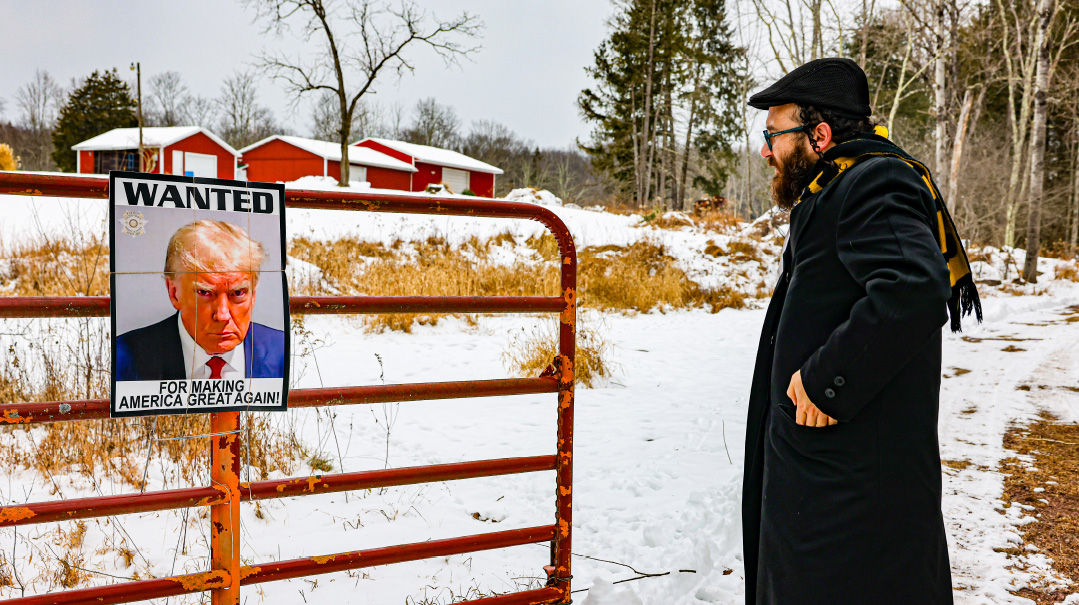
President Trump didn’t just bring a rally to the Poconos this week; he brought a gravitational pull.
The kind that draws out factory workers, small-town shop owners, retired miners, and yes, the occasional White House correspondent who has far more personal connections to these mountains than he lets on.
Trump’s message was simple enough to fit on a diner placemat: The economy is back, inflation is over, and Pennsylvania, especially this stretch of mountains and mining towns, is poised for a comeback. Trump repeatedly returned to his economic talking points even as his speech wandered into broader grievances. Defending his record, insisting, “I have no higher priority than making America affordable again,” while also acknowledging critics’ concerns by conceding that “prices are too high.”
Before a backdrop of signs reading “Lower Prices, Bigger Paychecks,” he credited his policies with bringing down gasoline and other costs, and blamed his predecessor for creating high prices: “They gave you high prices… and we’re bringing them down rapidly.” Trump also touted tariffs, claiming they produce revenues of “hundreds of billions of dollars.” And he suggested Americans could tighten their belts on non-essentials by quipping, “You can give up certain products… you don’t need thirty-seven dolls.”
Judging by the applause, no one disagreed.
Seeing Trump talk about giving “the farmers a little help — $12 billion and they are so happy,” something in me stirred. Something older than any speech. For me, northeastern Pennsylvania is home turf.
My mother’s family, the Berlinskys, once worked the soil just a few miles from here, on a farm in a little cozy hamlet of White Haven, long before the interstate carved its way right through their land. They hauled milk cans at dawn, canned jam in the summer, prayed for rain in the dry months, and built a little shtetl on in the middle of Pennsylvania’s backwoods. Cousins lived in Hazleton. Stories lived everywhere.
“I have fun. I haven’t read practically anything off the stupid teleprompter,” Trump continued, his voice sounding amused with itself.
But as the applause rolled through the casino ballroom, I could heard the echo of families like mine, who carved out a life of faith and stubborn hope in these hills long before politics turned them into talking points.
Trump came to sell a message and I came to see what it lands on. The rally wasn’t the story so much as a political flare fired into the Pocono night, briefly illuminating the ground beneath it. And what I found weren’t slogans, but systems. Some still working, some barely hanging on and some living on hope alone.
Trump had come to talk about the future of America. But I came to trace the past that shaped me. And so begins a journey across northeastern Pennsylvania, which is part political travelogue, part homecoming, part search for the heartbeat of a region that raised my ancestors and, in more ways than I realized, still raises me.
RELATED CONTENT
Jewish Panama may be known for wealth, but its real treasure is a Torah revival
Rav Yitzchak Biton and his wife, Tamar, have become powerful symbols of faith for a nation under fire

A former financial wiz bridges the gap between virtual reality and eternal content
The Pnei Menachem's youngest child opens a rare window into his father’s mesirus nefesh for his chassidim — and for every Yid