Forever in Your Hands
 | February 3, 2026
Two years locked in tunnels taught freed hostage Bar Kuperstein Who holds the keys
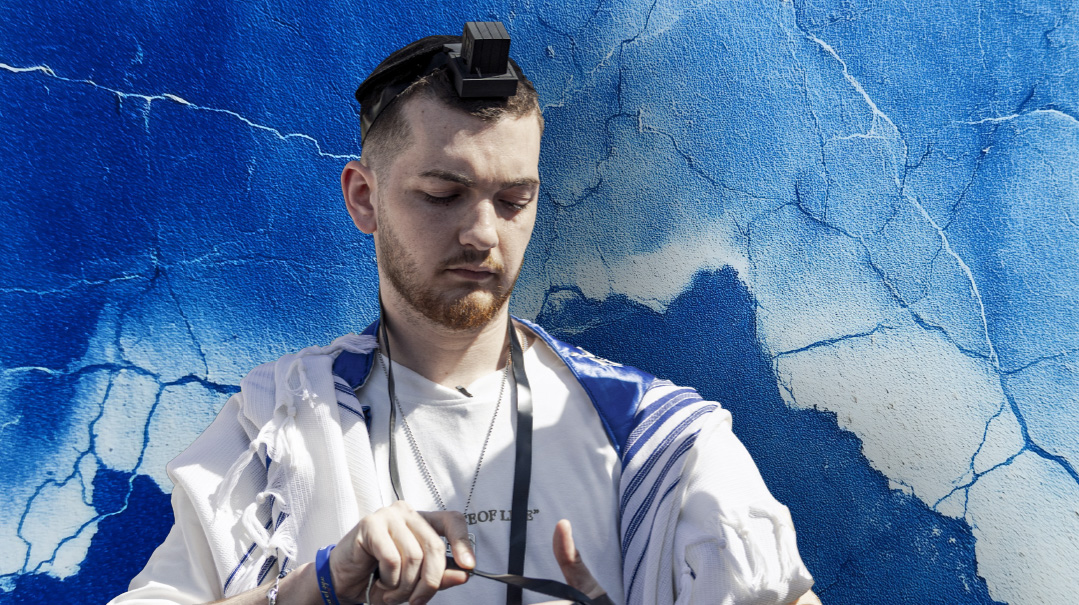 Photos: Menachem Kalish, Mishpacha, and Family archives
As the body of the last hostage was returned for kever Yisrael and the dark, gruesome chapter has come to some kind of closure, what of the live hostages, months after their return? “We’re living on a new level of reality,” says Bar Kuperstein. He’s grateful for the gift of perspective, but admits that even as he and his friends look pretty good on the outside, the scars and trauma will take another miracle to heal
“Shalom, Bar Kuperstein. How are you?”
It’s hard to believe I actually said the words I’d rehearsed countless times, ever since I spoke with Julie Kuperstein two years ago.
“One day, you’ll sit with Bar himself, and he’ll tell you everything,” his mother promised then, although at the time, when most of the captives were being held deep in the bowels of Gaza with no foreseeable way out, it didn’t seem remotely possible.
But Julie Kuperstein never lost her emunah compass, always talking about “the day of redemption.” She just knew the day would come.
“Shalom, shalom!” Bar answers effusively, his characteristic sweetness radiating outward — the top layer of an underlying steely strength.
For two years he was a sign, a photograph, a name for tefillah (Bar Avraham ben Julia) — someone people spoke about, saying, “If you’d meet him, you’d see how sweet he is.” And they were right.
He adjusts the backward baseball cap that’s become a symbol of his freedom — not exactly a yarmulke, yet a self-styled emblem of faith and connection in the darkest places.
He says one of the gifts of survival is the gift of perspective. He reminds me of how he reacted when his car was broken into last month.
“They smashed the window and stole my phone,” he recalls, “but you know what? It was okay. Thank G-d. Thank G-d I was busy with the headache of filing a police report instead of being in a tunnel a hundred feet below the surface, wondering what they would give me to eat, or if they would even give me food at all. This is a new level of reality.”
Because this last group of living hostages, released on Hoshana Rabbah through the Trump deal, actually looked surprisingly good on the outside when they were handed over to Israel, many of us tend to forget that they spent two years living in an alternate reality, a survival mode most of us can’t even imagine. We know they’re heroes, and we want them to get healed and get on with life. What we don’t see are the scars that are still fresh, and will likely remain forever.
“I’ll just give you an example of what happened last week,” Bar admits. “Not one of my most glorious moments. I was waiting in line at the pharmacy with my mom, trying to be patient while everyone else seemed to have all the time in the world, but then I felt myself starting to sweat. So I pulled out my ‘skip-the-line’ pass, but the pharmacist said he doesn’t honor it.
“Suddenly it was like a black screen fell over me, and I immediately stepped back to avoid exploding. In one second, I could have turned the entire checkout area upside down. I was already thinking what I would do, and somehow realizing how dysregulated I was, I took a step back and shouted to my mom, ‘He’s not willing to accept the pass!’ Suddenly I felt her wrapping me in a hug and that calmed me down.
“Yes, I couldn’t wait in line. It made me crazy. These are small things that trigger you. But I’m doing my best to become ‘normal’ again. Sometimes outside it’s pouring rain, freezing, and I’m walking without a jacket in a soaking-wet T-shirt, because inside I’m burning hot…. You know, people see us after captivity as if we’re normal, but it’s important to remember we went through extremely difficult things that continue to affect and haunt us.”
RELATED CONTENT
Rav Yitzchak Biton and his wife, Tamar, have become powerful symbols of faith for a nation under fire
Jewish Panama may be known for wealth, but its real treasure is a Torah revival

A former financial wiz bridges the gap between virtual reality and eternal content
The Pnei Menachem's youngest child opens a rare window into his father’s mesirus nefesh for his chassidim — and for every Yid