Back to the Future
 | December 9, 2025
Rabbi Meyer May spent years cultivating mega donors. Now he’s going back to nurturing souls
Photos: Elchanan Kotler
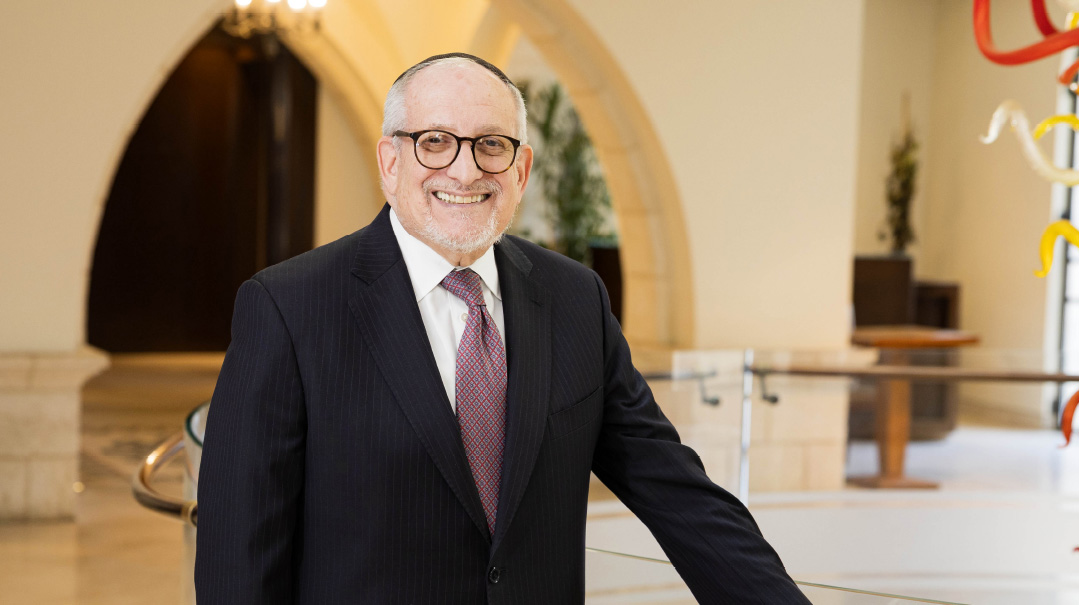
For half a century, Rabbi Meyer May cultivated mega-donors on behalf of the premier organization dedicated to hunting Nazis and fighting anti-Semitism. And yet, as he reaches retirement and the firewall that kept the oldest hatred out of the American mainstream has collapsed, the arc of his personal journey has bent back toward his first love — Jewish outreach.
Imagine you’ve spent a half-century building an organization into a world-renowned institution that does breakthrough programming, receives funding from the US government, and has branches across the globe. Over the decades, you raise more than one billion dollars. You’re on first-name terms with top figures in industry, and gain access to decision-makers from Washington, D.C. to the Gulf.
Then, as you approach retirement, the world undergoes seismic changes to the extent that the future of your life’s work is not clear.
That’s the situation that Rabbi Meyer May, the outgoing executive director of the Simon Wiesenthal Center and Museums of Tolerance, finds himself in.
Over decades operating out of Los Angeles, he’s helped oversee the SWC’s emergence as a juggernaut, leading the field in hunting Nazi war criminals, Holocaust research and remembrance, combating anti-Semitism, tolerance education, and defending Israel.
And yet, in the post-October 7 world, conditions have changed dramatically. Anti-Semitism has surged to shocking levels. In a perversion of Holocaust memory, those same charges of genocide are leveled at the Jewish state. The firewall that kept the oldest hatred out of the American mainstream has been eviscerated.
As Rabbi May himself puts it, “People say to me, ‘You stayed 48 years at the Simon Wiesenthal Center, but what did you achieve? They still hate us!’”
That very ability to take stock of his own life in such a clear-eyed way is part of Rabbi Meyer May’s story. Mentor to a generation of community leaders, mega-strategist and fundraiser for everything from establishing organizations to yeshivahs, his impact derives from the fact that his influential work wasn’t that of a careerist.
It was driven by a sense of mission to act for the Jewish people — one that stemmed from early exposure to Torah commitment. Old-time Lakewood and then Rav Soloveitchik at Yeshiva University put their stamp on him before he hit the road of Jewish activism.
“Everyone thought that I would be a pulpit rabbi, but ultimately I spent years involved in kiruv in L.A. in the movement’s infancy,” says Rabbi May.
Now, the arc of his history has bent back toward his first love — outreach. Having joined Aish as executive vice president with a mandate to mentor a new generation of staff as the kiruv powerhouse sets itself ambitious global targets, he gestures toward the view of the Kosel below the organization’s Jerusalem headquarters.
“This is the future of the Jewish people,” he says, “so this is where I want to be.”
RELATED CONTENT
Jewish Panama may be known for wealth, but its real treasure is a Torah revival
Rav Yitzchak Biton and his wife, Tamar, have become powerful symbols of faith for a nation under fire

A former financial wiz bridges the gap between virtual reality and eternal content
The Pnei Menachem's youngest child opens a rare window into his father’s mesirus nefesh for his chassidim — and for every Yid