Hidden Map of Dreznitz
| September 30, 2025The Chasam Sofer’s hidden map: ancient alleys and the secret to a baffling psak
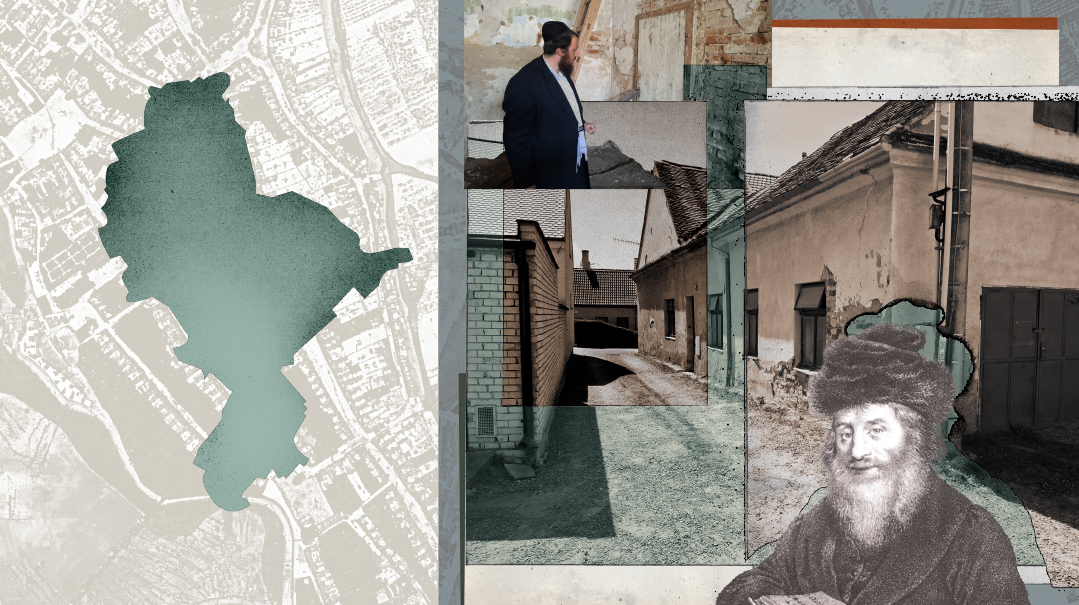
Photos Rav Menachem Meyer Yakobovitz, Mishpachah archives
A teshuvah of the Chasam Sofer about the eiruv in an ancient Czech town turned out to be more than a halachic analysis — it was also a paper trail with valuable clues to the city where he’d been rav. Guided by its hints, an American talmid chacham rediscovered the Chasam Sofer’s home just days before the property was to be sold and demolished. Treading through the old house, I never felt the past and present merge so intensely
ON a quiet, sunny afternoon in Strážnice, a small town in the Czech Republic, the streets are nearly deserted. An old truck rattles by, its driver staring in confusion at the group of black-hatted men who cluster beside a centuries-old stone house. The men are murmuring excitedly in Yiddish, their hands brushing over the walls as though the stones themselves might speak.
Suddenly, one of them cries out: “Here it is!”
At first glance, it seems absurd. The object of their excitement is nothing more than a protruding stone slab at the back corner of the building — just a weathered piece of masonry. I’ve never seen a crumbling angled pillar create so much excitement, yet to the men gathered, this lump of concrete is the key to a mystery, a confirmation that they’re standing on the very street once walked by Rav Moshe Schreiber, better known as the Chasam Sofer, one of the greatest halachic authorities of the modern era.
Each of the members of our group unfolds the “holy map” — a photocopy of the original page from Sh’eilos Uteshuvos Chasam Sofer. This page is dense with Hebrew text, written in Rashi script, and at first glance it seems to hold nothing but an intricate discussion of some particular laws of eiruvin — the regulations governing whether and how one may carry objects in a public area on Shabbos. Yet hidden in its lines is a surprising treasure: a detailed description of the Jewish quarter of Dreznitz (today’s Strážnice), preserved as it existed more than 230 years ago when the Chasam Sofer served for several years as rav of the town.
The teshuvah mentions houses, courtyards, a shul, even the home of a widow named Yocheved. It describes the Chasam Sofer’s own roundabout route to shul on Shabbos, and even mentions the lime plaster protruding from his window. In other words, it’s not merely a halachic text — it’s a description, with clear halachic ramifications, of the layout of the neighborhood.
Who would believe that now, after centuries of wars, communism, and devastation, this map would guide our group back to a forgotten Jewish world?
RELATED CONTENT

Jewish Panama may be known for wealth, but its real treasure is a Torah revival

Rav Yitzchak Biton and his wife, Tamar, have become powerful symbols of faith for a nation under fire

A former financial wiz bridges the gap between virtual reality and eternal content

The Pnei Menachem's youngest child opens a rare window into his father’s mesirus nefesh for his chassidim — and for every Yid