Season of Song and Fire
 | September 30, 2025
Rav Mottel Zilber’s inner fire ignites souls across the globe
Photos: Mishpacha, Toldos Yehuda-Stutchin archives
Rav Mordechai Zilber never intended to become a rebbe. But then he became a conduit for the Torah of his teacher, Rebbe Yehudah of Stutchin ztz”l, and today, Toldos Yehudah-Stutchin is its own fiery corner of Torah and avodah, with masses of talmidim flocking to Reb Mottel as he opens the gates to the deepest levels of service
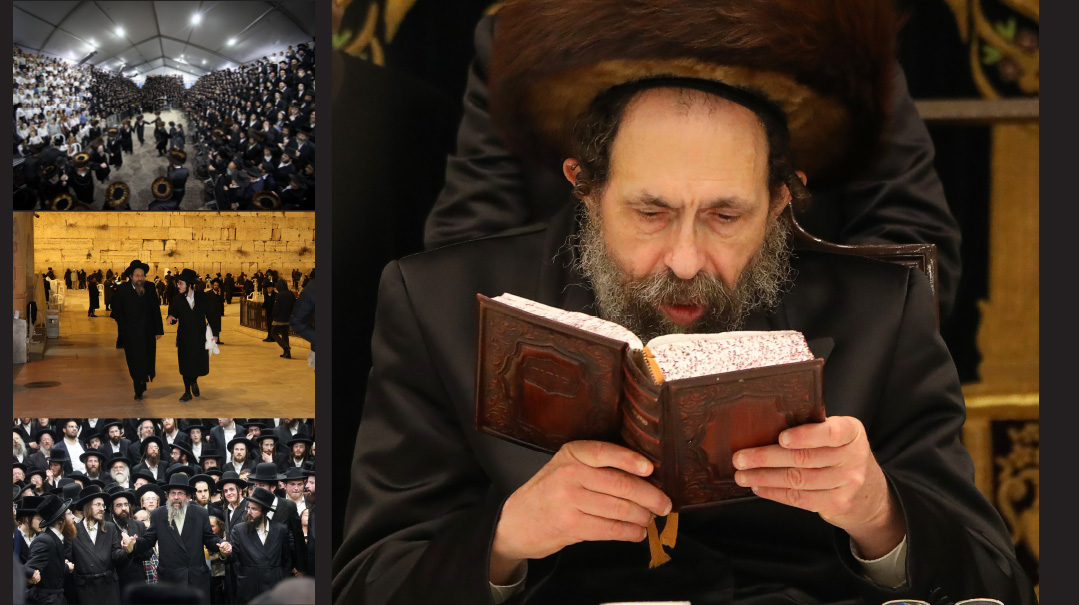
It’s 1:30 a.m. on a warm Shabbos night in Jerusalem. Inside a massive tent erected for the summer, a huge crowd of Yidden stand shoulder to shoulder, their eyes fixed on a slight figure at the head of a long table. The haunting notes of a well-known niggun rise and fall, filling the air with longing. Suddenly, the Rebbe’s voice — pleading, insistent — takes over: “Oy, libi uvesari yeranenu l’Keil Chai — My heart and my flesh, my heart and my flesh, will sing out to the living God.” The crowd responds, two thousand voices echoing the ancient cry with the haunting tune.
The niggun eventually shifts into dance. The Rebbe joins the circle, his feet moving with such speed and intensity that the crowd struggles to keep pace. It’s as if the holiness of Shabbos itself animates his thin frame.
To step into this tent is to enter a separate universe. Chassidim in both spodiks and shtreimels together with clean-shaven Litvaks stand alongside knitted-kippah wearers, as external boundaries dissolve. The magnet is Rav Mordechai Menashe Zilber, known simply as “Reb Mottel,” the Rebbe of Toldos Yehudah-Stutchin.
A man who began life in Paris, grew up in Boro Park, and now splits his time between Brooklyn and Jerusalem, Reb Mottel has become a spiritual phenomenon. His gatherings are part tish, part spiritual revolution, drawing those who yearn not only to belong but to search, to seek, and hopefully, also to find.
“It’s not just a tish,” says one avreich who spends every Shabbos with Reb Mottel during the weeks he’s in Eretz Yisrael. “It’s a meeting with eternity. You leave a changed person.”
For over three decades, Jerusalem has hosted this special summer pilgrimage. Each year, during the months of July and August, the Rebbe of Toldos Yehudah-Stutchin leaves his base in Boro Park and takes up residence in the Holy City, where throngs pour into his gatherings — his Shabbos tishen and weekday shiurim — to hear his words of Torah and chassidus, and to witness the fiery passion of his avodah.
The annual custom started years ago when, after spending several summers in the Catskills, Reb Mottel decided instead to travel to Eretz Yisrael. During those first few summers, staying in his father’s apartment in Har Nof, he basically kept to himself — no public shiurim — preferring to spend quiet days immersed in Torah learning. But he did venture out to daven in the nearby Vitzhnitz beis medrash, and that’s how he eventually became close to the Yeshuos Moshe of Vizhnitz (the previous Rebbe), who gave him great honor and drew him close.
The choice to spend his summers in Eretz Yisrael — practical at first — soon morphed into a spiritual tradition. For over 35 summers, the Rebbe has made Jerusalem his base, and each year the gatherings only grow larger.
Reb Mottel continues the legacy of the Ropschitz dynasty and Rav Naftali of Ropschitz, a towering disciple of Rebbe Elimelech of Lizhensk and Rebbe Menachem Mendel of Rimanov, known for his profound wisdom, sharp sense of humor, and profound musical gifts. Two hundred years later, Toldos Yehudah-Stutchin carries that flame forward, as the melodies, the emotional intensity, and the hunger for Geulah that marked Ropschitz are alive in Jerusalem’s summer nights — and all year long in a beis medrash in Brooklyn. For the chassidim, it’s a living tradition stretching back two centuries.
As the Jerusalem gatherings swelled year after year, the need for space became critical. The smaller halls that were rented couldn’t contain the growing crowds. Chassidim were thrilled when last summer, a huge tent with seating for 2,000 was erected in the courtyard of the main Bais Yaakov seminary on the corner of Minchas Yitzchak and Yirmiyahu streets.
You might think that, with such a crowd of admirers and supporters, Reb Mottel would be spending these months in one of the new beautifully furnished luxury high-rise apartments that have dotted the city in recent years. But in fact, we meet in a modest apartment, Rav Mottel sitting at a folding table surrounded by a stack of seforim and a disposable coffee cup, bent over Shaar HaKavanos of the Arizal.
Without getting into the contentious issues of drafting yeshivah students or the quagmire of Israeli politics, Reb Mottel doesn’t dismiss the miracle of Jewish survival in Eretz Yisrael. “There is no natural explanation,” he says. “Life here is a continuum of miracles, infused with an abundance of Torah and chassidus not found since the times of the Tannaim. HaKadosh Baruch Hu guards those who dwell in the Eretz Yisrael in a way that defies the natural order — that is His promise, and anyone who lives here and opens his eyes sees it. If not for my kehillah in the US, I would stay here all year round — it’s the greatest zechus.”
RELATED CONTENT
Jewish Panama may be known for wealth, but its real treasure is a Torah revival
Rav Yitzchak Biton and his wife, Tamar, have become powerful symbols of faith for a nation under fire

A former financial wiz bridges the gap between virtual reality and eternal content
The Pnei Menachem's youngest child opens a rare window into his father’s mesirus nefesh for his chassidim — and for every Yid